Public Policy for the People: Legislative Session Update
 Charlie Miller, GCDD Legislative Advocacy DirectorHello advocates, how in the world are you doing!!
We’re excited to bring you the March edition of our Public Policy for the People article. Y’all… we are heavy in session. When the House and Senate are moving at full speed, it can feel like drinking from a fire hose. The number of bills, the hearings, the amendments, the late nights—it’s a lot. But don’t worry. We’ll help you stay cool when the bills get hot.
In this article, we’re going to: walk through where we are in the legislative process, highlight a few key bills we’re tracking, break down what’s happening with the state budget, and talk about looming Medicaid cuts.
We’ll also share how you can plug in with us at our third and final advocacy day at the State Capitol on March 4, 2026.
Note: The information in this article is current as of 2/15/2026.
Where We Are in the Legislative Session
We are officially halfway through Georgia’s legislative session. Georgia’s session is one of the shortest in the country. It has only 40 legislative days. That means things move quickly, and deadlines matter.
One key date to keep in mind is Friday, March 6, which is Legislative Day 28. This day is better known as Crossover Day. Crossover Day is the day by which a bill must pass out of its original chamber (House or Senate) to remain alive for the session. If a Senate bill does not pass the Senate by Crossover Day, it cannot move to the House. If a House bill does not pass the House by Crossover Day, it cannot move to the Senate. Those bills would have to be reintroduced next year.
Crossover Day always brings long debates, last-minute votes, and sometimes surprises. It’s a turning point in the session, and we’re watching closely.
Bills We’re Following
We at GCDD are advocating for two critical educational policy changes. There has been a lot of conversation this year among teachers, parents, and the entire educational community about the need to update the way Georgia funds our public schools. This is known as the QBE, or Quality Basic Education Act. It was created in 1985 and has not had a major update since! GCDD is working with policymakers and partners on the importance of creating a commission to update QBE for all students, including students with disabilities.
We are also advocating to keep a good practice going in higher education. In 2023, the state created Inclusive Post-Secondary Education (IPSE) grants. These grants allow students attending IPSE programs to use state scholarship money. That is important because IPSE students are not eligible for HOPE scholarships. Right now, the IPSE grants are scheduled to end in a few years. We are advocating to make them permanent.
There are two bills in particular that we’re watching because of their impact on the disability community.
First is Georgia Senate Bill 403, sponsored by Blake Tillery. This bill would expand an existing pilot program that provides autism spectrum disorder screenings, clinical evaluations, training, services, and resources to children in foster care. Rather than creating something brand new, SB 403 builds on a program that already exists and hopes to offer it statewide.
The goal is simple but powerful: ensure that more foster children across Georgia are screened for autism and connected with appropriate support earlier. The program would continue to be developed and managed by the Division of Family and Children Services within the Georgia Department of Human Services. Finding and helping children early can make a big difference in how their lives turn out, especially for children already navigating the foster care system.
The second bill we’re watching is Georgia Senate Bill 433. This legislation would create special license plates for individuals with autism spectrum disorder or other developmental disabilities, as well as for their spouse, parent, or legal guardian. It also requires additional training for peace officers on how to properly recognize and interact with individuals who have autism or developmental disabilities.
That training would involve work between the Georgia Department of Community Health and nonprofit organizations to ensure officers are better prepared for these encounters. The goal is safety, dignity, and better outcomes during interactions that can sometimes end badly because of misunderstandings or a lack of awareness.
Both of these bills directly touch the disability community. We’re watching them closely and making sure your voices are part of the conversation.
The Budget: The Big Conversation
Now let’s talk about the budget—because while policy matters, funding is what makes services real.
Unlike most legislation, the state budget is not affected by Crossover Day. It will move through the process regardless, and it’s one of the most important pieces of legislation each year.
At the beginning of January, the governor presented his proposed Fiscal Year 2027 budget. This budget included funding for only 100 new waivers. Since then, we’ve moved through high-level House and Senate Appropriations Committee meetings. Now the real advocacy begins.
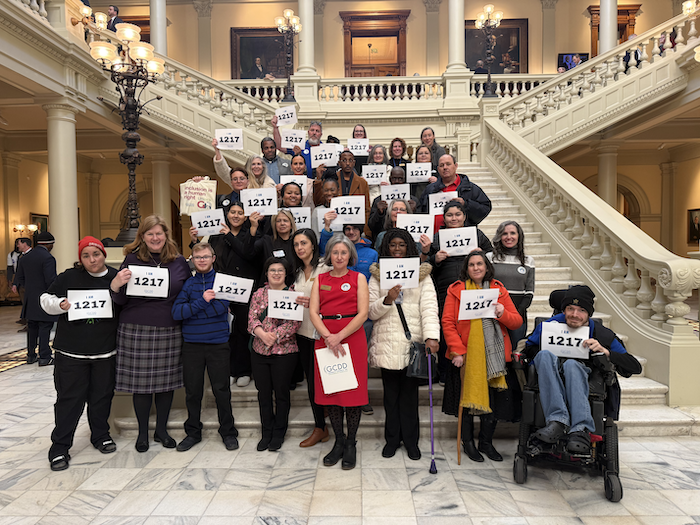 GCDD and Advocates at the Capitol During the 2026 Legislative SessionCurrently, the House Appropriations Subcommittee on Health and Human Services is hearing from state agencies and advocates about why funding matters. This is where your voice is critical.
GCDD is advocating for 1,217 waivers in both the amended and new budgets. You may have heard that more than 7,800 people with disabilities are on the waiver waitlist. While that number is accurate, it doesn’t tell the whole story. It does not tell the difference between someone who needs help right now and someone who might still be in school or have other people to lean on.
Over the past year, we have worked closely with the Department of Behavioral Health and Developmental Disabilities (DBHDD) to better understand and improve how waiver needs are reviewed. Through that teamwork, a new tool was created to better spot the people who need help the most.
Early data from that checklist shows that 1,217 people with disabilities are currently rated as critical or urgent. These are people who are already in crisis or at high risk of entering crisis. Without immediate access to a waiver, many could end up in hospitals, nursing facilities, or other expensive care systems. That results in greater expense to the state and, more importantly, poorer outcomes for the individual.
Paying for these 1,217 waivers is not just the kind thing to do — it also makes good financial sense. This is a powerful moment to reach out to members of the House Appropriations Subcommittee on Health and Human Services and share why waiver funding matters to you and your family. Personal stories move policymakers. We’ve made it easy with a link that allows you to send a pre-written email directly to committee members and the Governor’s office. Take a few minutes to act. It truly makes a difference. Here’s the link: https://gcdd.quorum.us/campaign/155704/
We are working every step of the way to make sure the disability community is always clearly heard under the Gold Dome.
Clouds on the Horizon: Federal Medicaid Cuts
While we are focused on state-level advocacy, we cannot ignore what is happening at the federal level.
Last year, Congress passed HR1, also referred to as “the big, beautiful bill.” This sweeping spending cut and tax package would have a big impact on states. Now that the dust is settling, it’s becoming clear that Medicaid in Georgia may look dramatically different in the coming years.
Georgia’s Medicaid program supports more than 200,000 people with disabilities, out of over 2 million total residents enrolled. That translates to roughly $10 billion in federal funding flowing into our state to support healthcare services.
For people with intellectual and developmental disabilities, Medicaid is not optional; it is foundational. It covers doctor visits, hospital care, dental services, therapies, and non-emergency medical transportation. It also covers critical programs like the Independent Care Waiver Program (ICWP) waiver and the Katie Beckett waiver. Many individuals qualify for Medicaid but do not qualify for a waiver. Medicaid is often the thread holding everything together.
If federal cuts reduce the amount of funding coming to Georgia, the state will be forced to make difficult decisions. That could mean reduced services, harder rules to qualify, or increased strain on families.
We cannot afford to be silent.
No Cuts to Care! Join Us on March 4th at the Gold Dome
GCDD is hosting our third and final legislative Advocacy Day on March 4 at the State Capitol. If you are concerned about how waiver funding or potential Medicaid cuts could affect you, your family member, or your community, this is your moment to show up.
We’ll gather in the morning, go over key talking points, and then head to the Capitol to meet with legislators. You will share why these services matter. You will learn about the real-life impact of policy decisions. And you will remind our elected officials that behind every line item in the budget is a person.
Advocacy can feel intimidating, but you are not alone. When the disability community comes together, the collective voice is strong.
We are halfway through the session. There is still time to influence outcomes. There is still time to fund waivers. There is still time to protect care.
Keep showing up. Keep speaking up. And keep pushing forward—together.